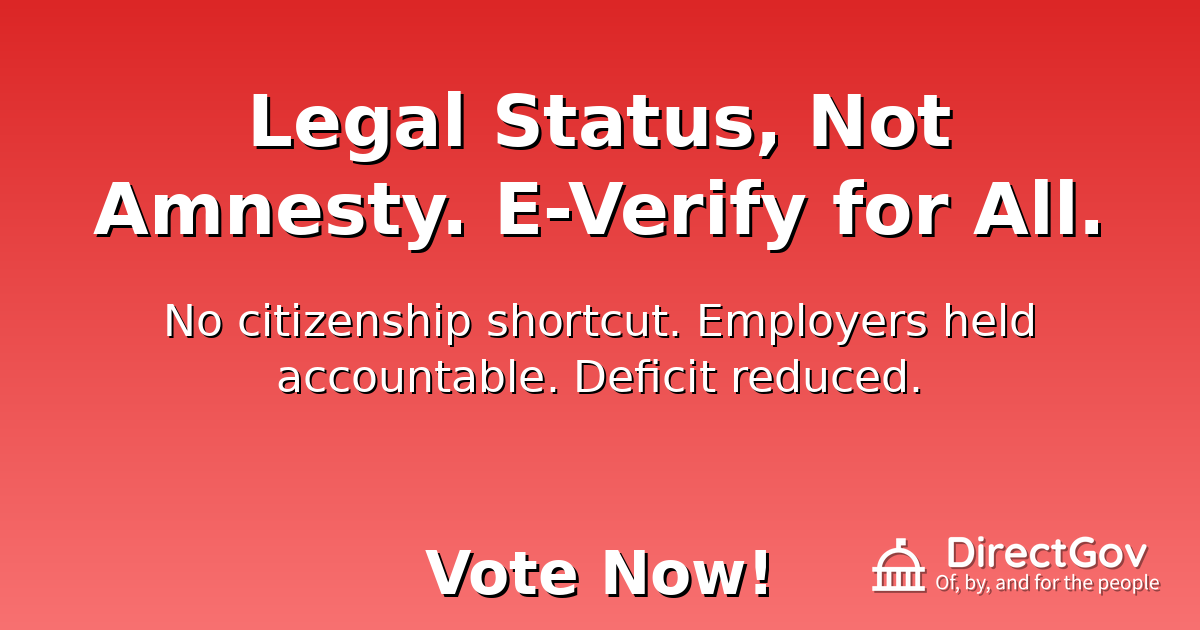
📜 Congressional Bill
119th CONGRESS
2d Session
H.R. ___
To amend the Immigration and Nationality Act to establish a Conditional
Resident Worker visa classification for certain long-term resident aliens,
to require all employers to participate in the E-Verify electronic
employment eligibility verification system, and for other purposes.
_______________________________________________________________________
IN THE HOUSE OF REPRESENTATIVES
M___ __, 2026
Mr./Ms. __________ introduced the following bill; which was referred to
the Committee on the Judiciary, and in addition to the Committee on Ways
and Means, for a period to be subsequently determined by the Speaker, in
each case for consideration of such provisions as fall within the
jurisdiction of the committee concerned
_______________________________________________________________________
A BILL
To amend the Immigration and Nationality Act to establish a Conditional
Resident Worker visa classification for certain long-term resident aliens,
to require all employers to participate in the E-Verify electronic
employment eligibility verification system, and for other purposes.
Be it enacted by the Senate and House of Representatives of
the United States of America in Congress assembled,
SECTION 1. SHORT TITLE; TABLE OF CONTENTS.
(a) Short Title.--This Act may be cited as the "Balanced
Immigration Reform Act of 2026".
(b) Table of Contents.--The table of contents for this Act
is as follows:
Sec. 1. Short title; table of contents.
Sec. 2. Findings.
Sec. 3. Definitions.
TITLE I--CONDITIONAL RESIDENT WORKER VISA
Sec. 101. Establishment of Conditional Resident Worker visa
classification.
Sec. 102. Eligibility requirements.
Sec. 103. Rights and conditions of Conditional Resident Worker
status.
Sec. 104. Revocation of Conditional Resident Worker status.
Sec. 105. Prohibition on adjustment to immigrant status or
naturalization.
Sec. 106. Tax obligations and benefit eligibility.
Sec. 107. Application procedures and fees.
Sec. 108. Authorization of appropriations for Title I.
TITLE II--MANDATORY EMPLOYMENT ELIGIBILITY VERIFICATION
Sec. 201. Mandatory participation in the E-Verify Program.
Sec. 202. Scope of covered workers.
Sec. 203. Penalties for noncompliance.
Sec. 204. Rulemaking and implementation timeline.
Sec. 205. Authorization of appropriations for Title II.
Sec. 301. Effective date.
Sec. 302. Severability.
SECTION 2. FINDINGS.
Congress finds the following:
(1) The United States is a nation of immigrants whose
economic vitality, cultural richness, and innovative capacity
have been strengthened throughout its history by the
contributions of individuals who have come to this country
seeking opportunity.
(2) An estimated 11,000,000 or more undocumented aliens
reside in the United States, many of whom have lived in the
country for years or decades, are gainfully employed, pay
taxes, and contribute to their communities.
(3) The aging demographics of the United States population
require sustained immigration to support economic growth,
maintain the solvency of entitlement programs, and sustain
innovation and competitiveness.
(4) The current immigration system fails to provide a
practical mechanism for long-term, law-abiding, undocumented
residents to regularize their status, creating a shadow
population that is vulnerable to exploitation and unable to
fully participate in the economy.
(5) Providing a legal status that does not include a path
to citizenship or lawful permanent residence represents a
balanced approach that acknowledges the contributions of
long-term undocumented residents without disadvantaging those
who have applied for immigration benefits through established
legal channels.
(6) Requiring all employers to verify the work
authorization of all workers through the E-Verify system will
significantly reduce the economic incentive for future
unauthorized immigration and create a more level playing field
for employers who comply with the law.
(7) A comprehensive approach that combines legal status for
qualifying long-term residents with robust employment
verification requirements serves the national interest by
bringing undocumented residents into the formal economy while
deterring future unauthorized immigration.
SECTION 3. DEFINITIONS.
In this Act:
(1) CONDITIONAL RESIDENT WORKER STATUS.--The term
"Conditional Resident Worker status" means the nonimmigrant
status described in section 101(a)(15)(W) of the Immigration
and Nationality Act, as added by section 101 of this Act.
(2) CRW VISA.--The term "CRW visa" means a nonimmigrant
visa issued pursuant to section 101(a)(15)(W) of the
Immigration and Nationality Act, as added by section 101 of
this Act.
(3) COVERED WORKER.--The term "covered worker" has the
meaning given such term in section 202 of this Act.
(4) E-VERIFY PROGRAM.--The term "E-Verify Program" means
the electronic employment eligibility verification system
established under section 403(a) of the Illegal Immigration
Reform and Immigrant Responsibility Act of 1996 (division C of
Public Law 104-208; 8 U.S.C. 1324a note), as operated by the
Secretary of Homeland Security, or any successor electronic
employment verification system.
(5) EMPLOYER.--The term "employer" means any person or
entity, including any individual, partnership, corporation,
association, or other legal entity, that employs, hires,
recruits, or refers for a fee any individual for employment in
the United States.
(6) SECRETARY.--Unless otherwise specified, the term
"Secretary" means the Secretary of Homeland Security.
(7) VIOLENT FELONY.--The term "violent felony" means any
offense that--
(A) is classified as a felony under Federal or State
law; and
(B) is a crime of violence as defined in section 16 of
title 18, United States Code.
TITLE I--CONDITIONAL RESIDENT WORKER VISA
SECTION 101. ESTABLISHMENT OF CONDITIONAL RESIDENT WORKER VISA
CLASSIFICATION.
(a) In General.--Section 101(a)(15) of the Immigration and
Nationality Act (8 U.S.C. 1101(a)(15)) is amended--
(1) in the subparagraph (V), by striking the period at
the end and inserting "; or"; and
(2) by adding at the end the following:
"(W) subject to section 214(s), an alien who--
"(i) has been continuously physically present in the
United States for a period of not less than 5 years
immediately preceding the date of the filing of an
application for classification under this subparagraph;
"(ii) has been gainfully employed in the United States
for a substantial portion of such 5-year period, as
determined by the Secretary of Homeland Security by
regulation;
"(iii) has not been convicted of any felony offense
under Federal or State law; and
"(iv) is not inadmissible under subparagraphs (A),
(B), (C), or (E) of section 212(a)(2), except that the
Secretary of Homeland Security may waive inadmissibility
under subparagraph (A)(ii)(II) of such section for a
single offense of simple possession of 30 grams or less
of marihuana;
who is granted Conditional Resident Worker status
authorizing the alien to live, work, study, and reside in
the United States for an indefinite period, subject to the
conditions and limitations set forth in section 214(s).".
(b) Conforming Amendment to Nonimmigrant Admission
Provisions.--Section 214 of the Immigration and Nationality Act
(8 U.S.C. 1184) is amended by adding at the end the following
new subsection:
"(s) Conditional Resident Worker Status.--
"(1) IN GENERAL.--An alien classified under section
101(a)(15)(W) shall be authorized to remain in the United
States for an indefinite period and shall be authorized to
accept employment with any employer in the United States
without restriction as to the type or duration of such
employment.
"(2) TRAVEL.--An alien in Conditional Resident Worker
status may travel outside the United States and be
readmitted upon presentation of valid documentation of
such status, provided that any single absence from the
United States does not exceed 180 consecutive days unless
the alien has obtained advance permission from the
Secretary of Homeland Security.
"(3) DEPENDENTS.--The spouse and unmarried children
under the age of 21 of an alien classified under section
101(a)(15)(W) may be granted derivative Conditional
Resident Worker status if such spouse or child--
"(A) has been continuously physically present in
the United States for a period of not less than 5
years immediately preceding the date of the filing of
the application;
"(B) has not been convicted of any felony offense
under Federal or State law; and
"(C) is otherwise admissible under section 212(a),
subject to the same waivers available to the
principal alien.
"(4) DOCUMENTATION.--The Secretary of Homeland
Security shall issue to each alien granted Conditional
Resident Worker status an employment authorization
document and such other documentation as the Secretary
determines appropriate to evidence the alien's status and
authorization to remain in and be employed in the United
States.
"(5) NO NUMERICAL LIMITATION.--The admission of aliens
under section 101(a)(15)(W) shall not be subject to any
numerical limitation.
"(6) RENEWAL.--Conditional Resident Worker status
shall not require periodic renewal, except that the
Secretary of Homeland Security may require the alien to
report a change of address within 10 days of such change
and to appear for biometric data collection at intervals
not more frequent than once every 10 years.".
SECTION 102. ELIGIBILITY REQUIREMENTS.
(a) Continuous Physical Presence.--
(1) IN GENERAL.--For purposes of section 101(a)(15)(W)
of the Immigration and Nationality Act, as added by
section 101, an alien shall be considered to have been
continuously physically present in the United States if
the alien has maintained a principal residence in the
United States during the 5-year period immediately
preceding the date of application and has not been absent
from the United States for any single period exceeding 90
days or for an aggregate period exceeding 180 days during
such 5-year period.
(2) EVIDENCE.--An applicant may establish continuous
physical presence through any credible evidence,
including but not limited to--
(A) tax returns or tax filings, including
Individual Taxpayer Identification Number (ITIN)
filings;
(B) employment records, pay stubs, or employer
attestations;
(C) lease agreements, mortgage records, or utility
bills;
(D) school enrollment records for the applicant or
the applicant's children;
(E) medical records;
(F) bank account statements or financial records;
or
(G) sworn affidavits from individuals with
personal knowledge of the applicant's residence.
(b) Employment Requirement.--
(1) IN GENERAL.--An applicant shall demonstrate that
the applicant has been gainfully employed, whether as an
employee or as a self-employed individual, for not less
than 18 months of the 5-year period described in
subsection (a)(1).
(2) EXCEPTIONS.--The Secretary may waive or reduce the
employment requirement under paragraph (1) for an
applicant who demonstrates that the applicant was--
(A) the primary caregiver of a minor child or
disabled family member during the relevant period;
(B) enrolled as a full-time student at an
accredited educational institution during the
relevant period; or
(C) unable to work due to a documented medical
condition during the relevant period.
(c) Criminal History.--
(1) IN GENERAL.--An applicant shall not be eligible
for Conditional Resident Worker status if the applicant
has been convicted of--
(A) any felony offense under Federal or State law;
or
(B) three or more misdemeanor offenses under
Federal or State law (excluding minor traffic
violations).
(2) BACKGROUND CHECK.--The Secretary, in consultation
with the Director of the Federal Bureau of Investigation,
shall conduct a thorough background check of each
applicant, including a search of all relevant Federal and
State criminal databases.
SECTION 103. RIGHTS AND CONDITIONS OF CONDITIONAL RESIDENT
WORKER STATUS.
(a) Rights.--An alien granted Conditional Resident Worker
status under section 101(a)(15)(W) of the Immigration and
Nationality Act, as added by section 101, shall have the
following rights:
(1) EMPLOYMENT.--The right to accept lawful employment
with any employer in the United States without restriction
as to occupation, industry, or duration.
(2) RESIDENCE.--The right to reside in any State,
territory, or possession of the United States.
(3) EDUCATION.--The right to enroll in and attend any
public or private educational institution in the United
States on the same terms as a lawful permanent resident.
(4) TRAVEL.--The right to travel outside the United
States and return, subject to the conditions set forth in
section 214(s)(2) of the Immigration and Nationality Act,
as added by section 101.
(5) DUE PROCESS.--The right to due process of law in
any proceeding to revoke Conditional Resident Worker
status, including the right to counsel at no expense to
the Government, the right to present evidence, and the
right to appeal an adverse determination.
(b) Conditions.--An alien granted Conditional Resident
Worker status shall--
(1) comply with all Federal, State, and local laws;
(2) pay all applicable Federal, State, and local
taxes, including income taxes, Social Security taxes under
sections 3101 and 3111 of the Internal Revenue Code of
1986, and Medicare taxes;
(3) maintain a valid mailing address on file with
United States Citizenship and Immigration Services and
report any change of address within 10 days; and
(4) not be eligible for any means-tested Federal
public benefit (as defined in section 403 of the Personal
Responsibility and Work Opportunity Reconciliation Act of
1996 (8 U.S.C. 1613)) during the first 5 years after the
date on which the alien is granted Conditional Resident
Worker status, except as otherwise provided in this Act.
SECTION 104. REVOCATION OF CONDITIONAL RESIDENT WORKER STATUS.
(a) Sole Ground for Revocation.--Conditional Resident
Worker status granted under section 101(a)(15)(W) of the
Immigration and Nationality Act, as added by section 101, may
be revoked only if the alien is convicted of a violent felony,
as defined in section 3(7) of this Act.
(b) Proceedings.--
(1) NOTICE.--Upon the conviction of an alien in
Conditional Resident Worker status for a violent felony,
the Secretary shall provide written notice to the alien of
the intent to revoke such status. Such notice shall--
(A) specify the conviction that forms the basis
for revocation;
(B) inform the alien of the right to contest the
revocation in a hearing before an immigration judge;
and
(C) be served on the alien not later than 30 days
after the Secretary receives notification of the
conviction.
(2) HEARING.--The alien shall have the right to a
hearing before an immigration judge within 60 days of the
date of service of the notice described in paragraph (1).
At such hearing, the alien may--
(A) be represented by counsel at no expense to the
Government;
(B) present evidence and witnesses; and
(C) challenge the validity of the underlying
conviction.
(3) BURDEN OF PROOF.--The burden of proof in a
revocation proceeding shall be on the Department of
Homeland Security to establish, by clear and convincing
evidence, that the alien has been convicted of a violent
felony.
(4) APPEAL.--An alien whose Conditional Resident
Worker status is revoked following a hearing under
paragraph (2) may appeal such revocation to the Board of
Immigration Appeals and, thereafter, to the appropriate
United States Court of Appeals.
(c) Effect of Revocation.--Upon final revocation of
Conditional Resident Worker status, the alien shall be subject
to removal proceedings under section 240 of the Immigration and
Nationality Act (8 U.S.C. 1229a).
(d) No Other Basis for Removal.--Notwithstanding any other
provision of the Immigration and Nationality Act, an alien in
valid Conditional Resident Worker status shall not be subject to
removal from the United States on any ground other than the
revocation of such status as provided in this section.
SECTION 105. PROHIBITION ON ADJUSTMENT TO IMMIGRANT STATUS OR
NATURALIZATION.
(a) No Adjustment of Status.--An alien in Conditional
Resident Worker status under section 101(a)(15)(W) of the
Immigration and Nationality Act, as added by section 101--
(1) shall not be eligible to apply for adjustment of
status to that of an alien lawfully admitted for permanent
residence under section 245 of the Immigration and
Nationality Act (8 U.S.C. 1255) on the basis of such
Conditional Resident Worker status;
(2) shall not be eligible to apply for an immigrant
visa under section 201, 202, or 203 of the Immigration
and Nationality Act (8 U.S.C. 1151, 1152, or 1153) on the
basis of such Conditional Resident Worker status; and
(3) shall not accrue any period of "continuous
residence" or "physical presence" for purposes of
establishing eligibility for naturalization under chapter
2 of title III of the Immigration and Nationality Act (8
U.S.C. 1421 et seq.) on the basis of time spent in
Conditional Resident Worker status.
(b) Preservation of Other Immigration Processes.--Nothing
in this section shall be construed to prevent an alien in
Conditional Resident Worker status from--
(1) being the beneficiary of an independently filed
immigrant visa petition by a qualifying family member who
is a United States citizen or lawful permanent resident,
provided that such petition is adjudicated under the same
standards and subject to the same numerical limitations
and waiting periods as apply to all other similarly
situated aliens; or
(2) applying for any other immigration benefit for
which the alien may independently qualify, provided that
Conditional Resident Worker status shall not be counted as
a factor in favor of or against such application.
SECTION 106. TAX OBLIGATIONS AND BENEFIT ELIGIBILITY.
(a) Tax Obligations.--
(1) IN GENERAL.--An alien in Conditional Resident
Worker status shall be subject to all Federal, State, and
local tax obligations applicable to resident aliens,
including--
(A) Federal income taxes under subtitle A of the
Internal Revenue Code of 1986;
(B) the taxes imposed by section 3101 of the
Internal Revenue Code of 1986 (relating to the
employee share of Social Security and Medicare taxes
under the Federal Insurance Contributions Act); and
(C) any applicable State and local income, sales,
and property taxes.
(2) INDIVIDUAL TAXPAYER IDENTIFICATION NUMBERS.--The
Secretary of the Treasury shall issue a Social Security
number to each alien granted Conditional Resident Worker
status for purposes of tax administration and employment,
in accordance with section 205(c)(2) of the Social
Security Act (42 U.S.C. 405(c)(2)).
(b) Social Security and Medicare Benefit Eligibility.--
(1) SOCIAL SECURITY.--An alien in Conditional Resident
Worker status who satisfies the requirements for insured
status under section 214 of the Social Security Act (42
U.S.C. 414), including the requirement of 40 qualifying
quarters of coverage, shall be eligible for old-age,
survivors, and disability insurance benefits under title
II of the Social Security Act (42 U.S.C. 401 et seq.) on
the same basis as any other individual who satisfies such
requirements.
(2) MEDICARE.--An alien in Conditional Resident Worker
status who satisfies the requirements for entitlement to
hospital insurance benefits under section 226 of the
Social Security Act (42 U.S.C. 426) shall be eligible for
benefits under title XVIII of the Social Security Act (42
U.S.C. 1395 et seq.) on the same basis as any other
individual who satisfies such requirements.
(3) TREATMENT AS LAWFULLY PRESENT.--For purposes of
eligibility for benefits under titles II and XVIII of the
Social Security Act, an alien in Conditional Resident
Worker status shall be treated as an alien lawfully
present in the United States.
(c) Employer Obligations.--Each employer of an alien in
Conditional Resident Worker status shall comply with all
applicable employer tax obligations, including the taxes imposed
by section 3111 of the Internal Revenue Code of 1986 (relating
to the employer share of Social Security and Medicare taxes) and
section 3301 of such Code (relating to the Federal Unemployment
Tax Act), with respect to wages paid to such alien.
SECTION 107. APPLICATION PROCEDURES AND FEES.
(a) Application Period.--
(1) IN GENERAL.--The Secretary shall establish an
initial application period of not less than 24 months
beginning not later than 180 days after the date of
enactment of this Act during which eligible aliens may
apply for Conditional Resident Worker status.
(2) EXTENSION.--The Secretary may extend the initial
application period for one or more additional periods of
12 months each if the Secretary determines that such
extension is warranted.
(b) Application Fee.--
(1) IN GENERAL.--The Secretary shall charge an
application fee of $2,500 for each principal applicant for
Conditional Resident Worker status.
(2) DEPENDENTS.--The application fee for each
dependent applicant under section 214(s)(3) of the
Immigration and Nationality Act, as added by section 101,
shall be $1,000.
(3) FEE WAIVER.--The Secretary may waive or reduce the
application fee for an applicant who demonstrates an
inability to pay, provided that the fee shall not be
reduced below $500 for a principal applicant or $250 for a
dependent applicant.
(4) INSTALLMENT PAYMENTS.--The Secretary shall
establish a process by which applicants may pay the
application fee in installments over a period not to
exceed 24 months.
(c) Processing.--
(1) INTERIM STATUS.--Upon the filing of a complete
application and payment of the applicable fee (or first
installment thereof), the Secretary shall grant the
applicant interim work authorization and protection from
removal pending adjudication of the application.
(2) TIMELINE.--The Secretary shall adjudicate each
application not later than 365 days after the date on
which the application is filed.
(3) DENIAL.--If an application is denied, the
applicant shall be provided written notice of the reasons
for denial and shall have the right to appeal such denial
to the Administrative Appeals Office of United States
Citizenship and Immigration Services within 30 days of
such notice.
(d) Fraud Prevention.--
(1) PENALTIES.--Any alien who knowingly makes a
materially false statement or submits a fraudulent
document in connection with an application for Conditional
Resident Worker status shall be--
(A) permanently ineligible for Conditional
Resident Worker status;
(B) subject to a fine of not more than $10,000;
and
(C) subject to removal proceedings under section
240 of the Immigration and Nationality Act (8 U.S.C.
1229a).
(2) CONFIDENTIALITY.--Information provided by an
applicant in connection with an application for
Conditional Resident Worker status may not be used for any
purpose other than the adjudication of such application or
a prosecution for fraud under paragraph (1), except that
such information may be shared with law enforcement
agencies for the purpose of investigating or prosecuting
criminal activity unrelated to the applicant's immigration
status.
SECTION 108. AUTHORIZATION OF APPROPRIATIONS FOR TITLE I.
There are authorized to be appropriated to the Secretary
such sums as may be necessary to carry out this title,
including--
(1) the hiring and training of additional personnel
for United States Citizenship and Immigration Services to
process applications under this title;
(2) the development and deployment of information
technology systems necessary to administer the Conditional
Resident Worker program; and
(3) public outreach and education regarding the
availability of and requirements for Conditional Resident
Worker status.
TITLE II--MANDATORY EMPLOYMENT ELIGIBILITY VERIFICATION
SECTION 201. MANDATORY PARTICIPATION IN THE E-VERIFY PROGRAM.
(a) Amendment to the Immigration and Nationality Act.--
Section 274A of the Immigration and Nationality Act (8 U.S.C.
1324a) is amended--
(1) in subsection (a), by adding at the end the
following new paragraph:
"(5) MANDATORY USE OF E-VERIFY PROGRAM.--
"(A) IN GENERAL.--In addition to the requirements of
subsection (b), each employer shall participate in and use
the E-Verify Program (as defined in section 3(4) of the
Balanced Immigration Reform Act of 2026) to verify the
identity and employment eligibility of each covered worker
(as defined in section 202 of such Act) hired, engaged, or
contracted by the employer on or after the applicable date
described in subparagraph (B).
"(B) APPLICABLE DATES.--
"(i) EMPLOYERS WITH 500 OR MORE EMPLOYEES.--In the
case of an employer that employed an average of 500 or
more employees during the preceding calendar year, the
applicable date is the date that is 12 months after
the date of enactment of the Balanced Immigration
Reform Act of 2026.
"(ii) EMPLOYERS WITH 100 TO 499 EMPLOYEES.--In the
case of an employer that employed an average of 100 to
499 employees during the preceding calendar year, the
applicable date is the date that is 18 months after
the date of enactment of such Act.
"(iii) EMPLOYERS WITH 20 TO 99 EMPLOYEES.--In the
case of an employer that employed an average of 20 to
99 employees during the preceding calendar year, the
applicable date is the date that is 24 months after
the date of enactment of such Act.
"(iv) ALL OTHER EMPLOYERS.--In the case of any
other employer, the applicable date is the date that
is 36 months after the date of enactment of such Act.
"(C) TIMING OF VERIFICATION.--An employer shall
initiate a verification query through the E-Verify Program
with respect to each covered worker not later than 3
business days after the earlier of--
"(i) the date on which the covered worker begins
performing services for the employer; or
"(ii) the date on which the covered worker
completes the Employment Eligibility Verification Form
(Form I-9) or any successor form.
"(D) EXISTING WORKERS.--Not later than 36 months after
the applicable date described in subparagraph (B) with
respect to an employer, such employer shall use the
E-Verify Program to verify the identity and employment
eligibility of each covered worker who was hired, engaged,
or contracted before such applicable date and who remains
a covered worker of such employer.
"(E) RECORDS.--Each employer shall maintain records of
each E-Verify query and the results thereof for a period
of not less than 3 years after the date of such query or
the date on which the covered worker ceases to perform
services for the employer, whichever is later."; and
(2) in subsection (b), by adding at the end the
following new paragraph:
"(7) RELATIONSHIP TO E-VERIFY REQUIREMENT.--The
requirements of paragraph (5) of subsection (a) are in addition
to, and not in lieu of, the requirements of this subsection.
Compliance with the E-Verify Program requirement under such
paragraph (5) shall not relieve an employer of the obligation to
complete and retain the Employment Eligibility Verification Form
(Form I-9) as required by this subsection.".
SECTION 202. SCOPE OF COVERED WORKERS.
(a) Definition.--For purposes of this title and section
274A(a)(5) of the Immigration and Nationality Act, as added by
section 201, the term "covered worker" means any individual who
performs services for an employer in exchange for wages,
compensation, or other remuneration, including--
(1) any individual employed on a full-time, part-time,
temporary, or seasonal basis;
(2) any individual engaged as an independent
contractor or contract worker who performs services for the
employer at the employer's place of business or at a
location designated by the employer;
(3) any individual provided to the employer by a
staffing agency, temporary employment agency, or employee
leasing company;
(4) any individual engaged as a subcontractor, or
employed by a subcontractor, who performs services in
furtherance of a contract with the employer; and
(5) any individual engaged through a day labor
arrangement.
(b) Exceptions.--The term "covered worker" does not
include--
(1) an individual who performs casual domestic services
in a private home on an irregular or intermittent basis,
provided that such services do not exceed 20 hours in any
calendar month;
(2) an individual under the age of 18 who is employed
by a parent or legal guardian in a family-owned business;
or
(3) an individual who is a volunteer and receives no
wages, compensation, or other remuneration for services
performed.
(c) Employer Responsibility for Subcontractors.--
(1) IN GENERAL.--An employer that engages a
subcontractor or independent contractor shall--
(A) include in any contract or agreement with such
subcontractor or independent contractor a provision
requiring the subcontractor or independent contractor
to comply with the E-Verify requirements of section
274A(a)(5) of the Immigration and Nationality Act, as
added by section 201; and
(B) obtain from such subcontractor or independent
contractor a written attestation of compliance with
such requirements.
(2) LIABILITY.--An employer that obtains the
attestation described in paragraph (1)(B) and has no
actual knowledge of a subcontractor's or independent
contractor's noncompliance shall not be liable for such
subcontractor's or independent contractor's failure to
comply with the E-Verify requirements.
SECTION 203. PENALTIES FOR NONCOMPLIANCE.
(a) Civil Penalties.--Section 274A(e) of the Immigration
and Nationality Act (8 U.S.C. 1324a(e)) is amended by adding at
the end the following new paragraph:
"(10) PENALTIES FOR FAILURE TO USE E-VERIFY PROGRAM.--
"(A) IN GENERAL.--Any employer who fails to comply with
the requirements of subsection (a)(5) with respect to a
covered worker (as defined in section 202 of the Balanced
Immigration Reform Act of 2026) shall be subject to a
civil penalty of $25,000 for each covered worker with
respect to whom such a violation occurs during any 12-month
period.
"(B) DETERMINATION OF VIOLATIONS.--For purposes of
subparagraph (A), each covered worker with respect to whom
the employer has failed to initiate or complete an E-Verify
query as required by subsection (a)(5) shall constitute a
separate violation.
"(C) GOOD FAITH DEFENSE.--It shall be an affirmative
defense to a penalty under this paragraph that the
employer--
"(i) made a good faith effort to comply with the
requirements of subsection (a)(5);
"(ii) the failure to comply was the result of a
technical or procedural error that was isolated and
nonrecurring; and
"(iii) the employer corrected the error promptly
upon discovery.
"(D) PATTERN OR PRACTICE.--Any employer that engages
in a pattern or practice of violations of subsection
(a)(5) shall be subject to--
"(i) a civil penalty of $50,000 for each covered
worker with respect to whom such a violation occurs;
and
"(ii) debarment from participation in any Federal
contract for a period of not less than 1 year and not
more than 5 years.
"(E) INFLATION ADJUSTMENT.--The dollar amounts
specified in subparagraphs (A) and (D)(i) shall be
adjusted annually for inflation in accordance with the
Federal Civil Penalties Inflation Adjustment Act of 1990
(28 U.S.C. 2461 note), beginning in the first calendar
year after the date of enactment of the Balanced
Immigration Reform Act of 2026.
"(F) ENFORCEMENT.--The Secretary of Homeland Security
shall have authority to investigate and impose penalties
under this paragraph. The Secretary may delegate such
authority to Immigration and Customs Enforcement.".
(b) Anti-Discrimination Protections.--Nothing in this title
shall be construed to authorize or permit any employer to--
(1) discriminate against any individual on the basis
of national origin, citizenship status, or immigration
status in violation of section 274B of the Immigration and
Nationality Act (8 U.S.C. 1324b); or
(2) use the E-Verify Program selectively or in a
manner that discriminates against any individual or class
of individuals on the basis of national origin, race,
color, religion, sex, or any other protected
characteristic.
SECTION 204. RULEMAKING AND IMPLEMENTATION TIMELINE.
(a) Rulemaking.--Not later than 180 days after the date of
enactment of this Act, the Secretary shall promulgate
regulations to carry out this title, including--
(1) procedures for employer enrollment in the E-Verify
Program;
(2) standards for the verification of covered workers,
including independent contractors and subcontractors;
(3) procedures for resolving tentative
nonconfirmations and final nonconfirmations;
(4) recordkeeping requirements;
(5) procedures for investigating and imposing
penalties under section 203; and
(6) guidance on the application of the good faith
defense under section 274A(e)(10)(C) of the Immigration
and Nationality Act, as added by section 203.
(b) System Capacity.--The Secretary shall ensure that the
E-Verify Program has sufficient capacity, including information
technology infrastructure and personnel, to accommodate the
increased volume of queries resulting from the mandatory
participation requirements of this title.
(c) Accuracy Improvements.--The Secretary, in consultation
with the Commissioner of Social Security and the Secretary of
State, shall implement measures to improve the accuracy of the
E-Verify Program, including--
(1) reducing the rate of erroneous tentative
nonconfirmations;
(2) incorporating additional data sources to improve
identity verification; and
(3) establishing a process for individuals to lock
their Social Security numbers against unauthorized use in
the E-Verify system.
(d) Reports to Congress.--Not later than 1 year after the
date of enactment of this Act, and annually thereafter for 5
years, the Secretary shall submit to the Committee on the
Judiciary of the Senate and the Committee on the Judiciary of
the House of Representatives a report on the implementation of
this title, including--
(1) the number of employers enrolled in the E-Verify
Program;
(2) the number of queries processed;
(3) the rate of tentative nonconfirmations and final
nonconfirmations;
(4) the number and amount of penalties imposed under
section 203;
(5) any recommendations for legislative or
administrative changes to improve the effectiveness of the
E-Verify Program; and
(6) an assessment of the impact of mandatory E-Verify
participation on unauthorized employment.
SECTION 205. AUTHORIZATION OF APPROPRIATIONS FOR TITLE II.
There are authorized to be appropriated to the Secretary
$400,000,000 for each of fiscal years 2027 through 2031 to
carry out this title, including--
(1) the expansion and improvement of the E-Verify
Program's information technology infrastructure;
(2) the hiring and training of additional personnel to
administer and enforce the requirements of this title;
(3) employer outreach and education programs; and
(4) the development of a toll-free telephone hotline
and online resources to assist employers and workers with
E-Verify compliance.
SECTION 301. EFFECTIVE DATE.
(a) Title I.--Title I of this Act shall take effect on the
date of enactment of this Act, except that the Secretary shall
begin accepting applications for Conditional Resident Worker
status not later than 180 days after such date of enactment.
(b) Title II.--Title II of this Act shall take effect on
the date of enactment of this Act, subject to the phased
implementation schedule set forth in section 274A(a)(5)(B) of
the Immigration and Nationality Act, as added by section 201.
SECTION 302. SEVERABILITY.
If any provision of this Act, or the application of such
provision to any person or circumstance, is held to be
unconstitutional or otherwise invalid, the remainder of this
Act, and the application of such provision to other persons or
circumstances, shall not be affected thereby.
```
---